Chaim Meir Yechiel Engel, the oldest son of Israel and Ryfka, was born in Ryki in 1850. In some biographies he is called Rabbi Meir.
He is probably named after Rabbi Chaim Meir Yechiel Shapir, Seraph of Mogielnica (1789 – 7 May 1849, Mogielnica, Poland), grandson of Rabbi Yisrael of Koznitz, the Maggid of Koznitz.
Chaim Meir got a religious education. He was well-versed in Torah. Like the entire family, he was a follower of Kozienice Hasidism.
Chaim Meir worked as an “Esikmacher”, a producer of vinegar. Before 1877, he moved to Zelechow, a small Polish town located between Warsaw and Lublin, 20 km from Ryki.
Chaim Meir married to Pesia Rozenwajn. She died shortly after the birth of their son Avraham Shimon.
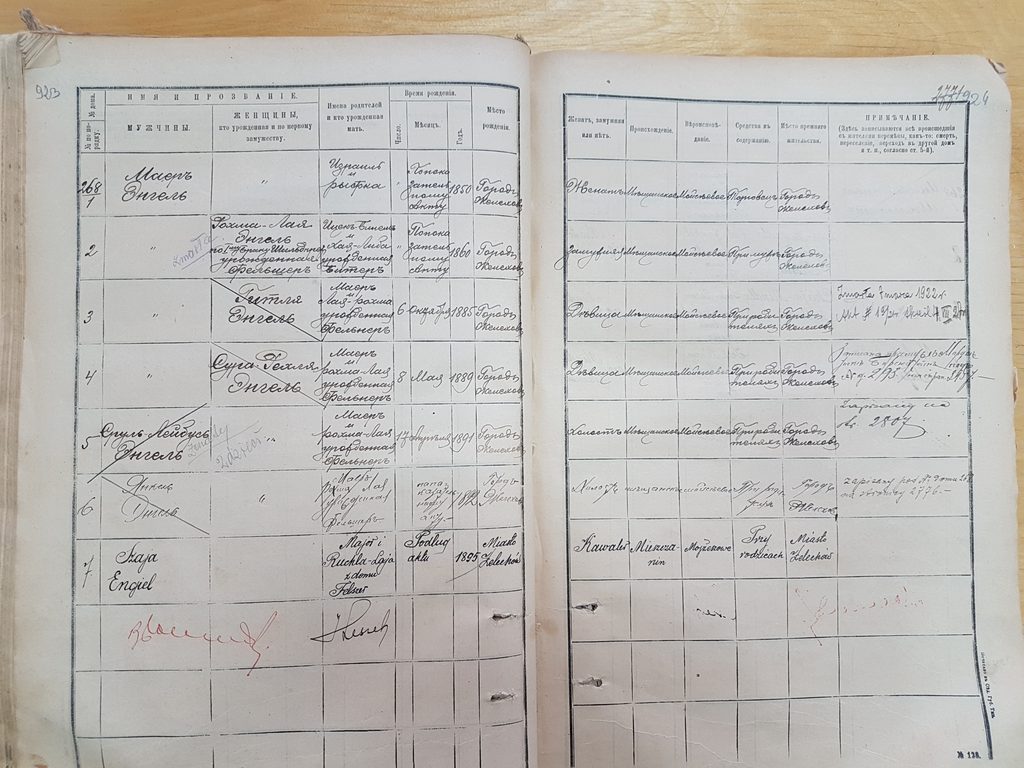
Chaim Meir remarried Rochma Laja Felszer, born 1860 in Zelechow, widow of Spielberg , and together they had at least five more children. The date of Chaim Meir’s death is unknown.
1.1 Rabbi Avraham Shimon Halevi Engel-Horowitz 1877-1943
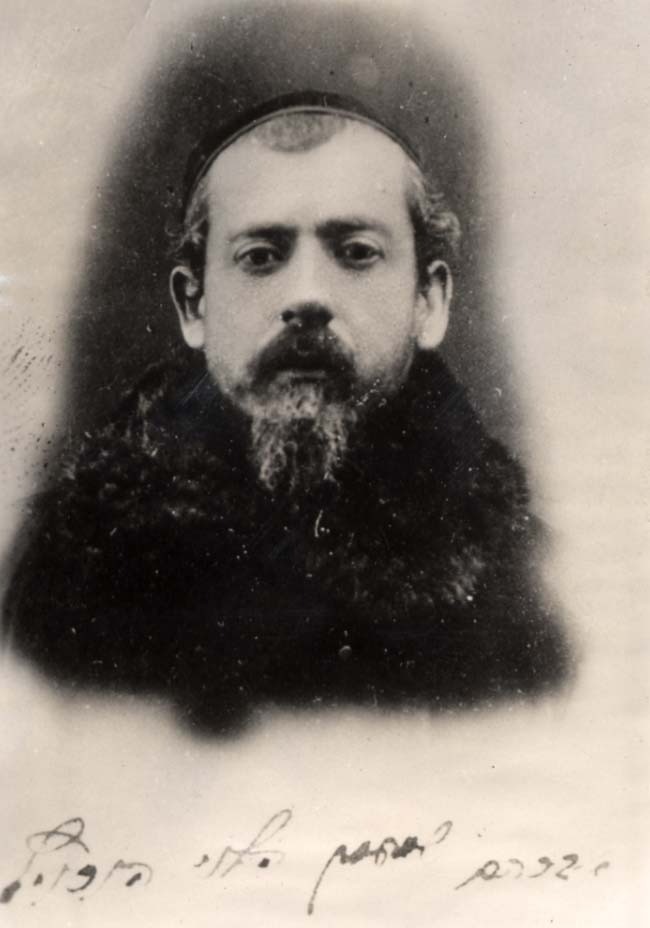
Shimon Engel1 was known under many names: Shmuel Meirs, Shimele Esikmakher, Reb Shimele of Zhelechov or even Rabbi Avraham Shimon Halevi Engel-Horowitz. He was born on February 6, 1877, in Zelechow. He was the son of Chaim Meir Yechiel Engel Horvitz and Pesia Rozenwajn.
Shimon learned Torah in a local shtibl of the Kozienice Hasidim. His mother Pesia passed away when he was young; his father remarried Rochma Laja Felszer and decided to send his son -about 6 years old- to the court of Avi Ezra Zelig Shapira (1840–1906), the rebbe of Kozienice-Mogielnica, son of Chaim Meir Yechiel Shapira.
In traditional Eastern European Jewish society, brilliant scholars like Engel were considered a catch. Wealthy parents sought out promising students to be their future sons-in-law and often supported the young couple financially while the new husband continued his religious studies.
Engel married Sarah Feigenbaum, the daughter of Moshe Feigenbaum, a merchant from the neighboring county seat of Garwolin. Following the wedding, the couple moved to Garwolin, where Engel studied in the shtibl of Ger (Gora Kalwaria) Hasidim, not becoming a Ger Hasid himself. Unfortunately, his wealthy father-in-law soon went bankrupt, and Engel was forced to interrupt his studies and look for work. He allegedly received several offers of rabbinical posts but declined them all; he preferred manual labor to the rabbinate, because he disapproved of using the Torah for financial gain and worldly glory. Rabbinic work, in his opinion: transformed the Torah into “a despicable spade”.
A need for work took Engel back to Zelechow. He followed in his father’s footsteps and opened a small vinegar factory. The factory did not survive long, however, at least partly because Shimele Esikmakher (Shimele the vinegar maker) would spend more time in the local shtibl than attending to business. When the factory went bankrupt, Engel worked in commerce, which allegedly took him to far-flung corners of the Russian Empire. It is unclear how long his career lasted, and what impact the revolution of 1905 and the First World War had on him, his family, and his life choices. In any case, its failure ended Engel’s hopes for earning his bread by the labor of his own hands. After an unsuccessful attempt to organize a group of students in his hometown (his demanding method of Torah interpretation quickly discouraged his potential students), he embarked on a career as an itinerant educator.
One may speculate about the reasons for Engel’s early wanderings. Perhaps his eccentric character and unconventional approach to Torah study—one which would eventually lead to his ouster from the Lublin yeshiva—played a role. Whatever the causes, by 1931 Engel was in dire financial straits. His son Mordechai Israel was tried and sentenced to a fine of 45,000 zlotys or two years in prison for illegal sale of industrial alcohol. The court proceedings must have been costly: Engel borrowed money to pay for a lawyer, and his son later appealed the verdict and took the case to the supreme court. Fortunately, Meir Shapira, head of the Lublin yeshiva, offered Engel a job and even gave him a one-off loan to cover his debts. Engel later claimed that he had been groomed for the position already in 1929 but when offered it had turned it down. The renewed offer was too good to refuse, and despite his strong feelings about working as a rabbi, Engel became a staff member at Yeshivat Hakhme Lublin.
Shimon Engel joined the yeshiva in 1931. He did not hold back his criticism, and one might surmise that what the founders took particular pride in—the yeshiva’s grandiose building, its scale and prestige, in short, everything that made it resemble a European university and a new tourist destination in Lublin—was for Engel a repugnant sign of the acculturation and spiritual demise of Polish Jewry. As Engel wrote in a discourse titled “Galut Mitsrayim” (Exile in Egypt) upon arrival in Lublin in the winter of 1931, he found the yeshiva to be “a spiritual wilderness” and a habitat of “natural pride”.
Part of the problem was the yeshiva’s curriculum. Engel criticized the yeshiva’s selectiveness in choosing teaching material, its excessive focus on Talmud,. Engel was so disappointed with what he saw as the hollow curriculum of the yeshiva that he later even questioned his own profession altogether.
He led communal prayers, delivered sermons based on kabbalah and Hasidic books, and accompanied the students at Sabbath meals.
His students remembered him as the first person to arrive in the yeshiva’s bet midrash every morning, praying and reading from the Torah in a clear, captivating voice. He enjoyed the reputation of a mystic, which sprang from his practice of studying ancient mystical books, like the “Shimusha Raba,” which teaches magical practices, and from other occasional mystical practices. Engel himself talked about his work with embarrassment. After all, any work is a waste of time that should be devoted to Torah and prayer.
A few months after the death of the head of the yeshiva (1933), tensions increased between him and the new leadership of the yeshiva, and the head of the yeshiva, Rebbe Shlomo Eiger of Lublin, ruled that he must leave the yeshiva. His students caused a great commotion in the yeshiva, and the police had to intervene to calm the spirits, his students were called “Simonians”. After his departure, he wrote a special article in which he explained in detail his method in worshiping God and studying the Torah, and answers to the claims of his opponents.
By 1935 he was a widower. He struggled financially to marry off his daughter Leah, lacking funds for a dowry. Finally, his life took a more positive turn when he received an offer of marriage—most likely in 1937. The bride, Leah bat Ester Gitel, was an orphan over two decades his junior. Despite Engel’s poverty and the age difference, the match went through. According to Engel his fiancee was happy to share an austere life with him on account of his scholarly reputation.
Leah (Laja) Handelsmann was born in Kamińsk on December 3, 1901. Her personal data are preserved in Engel’s 1940 application to the German occupation authorities in Krakow.
Engel published almost nothing, and he discouraged others from writing. He claimed that only books dictated by divine inspiration and necessary for the entire Jewish people deserve publication. Unsurprisingly then, although Engel allegedly wrote commentaries to the 613 commandments and to the Talmud, an index to Maharal’s books, a Hasidic kabbalistic treatise and several other books, none of these works has survived. Some he supposedly destroyed himself. There may have been other, more prosaic reasons related to money matters: in a 1938 letter, he mentions that his students had borrowed money to publish a pamphlet, presumably containing his discourses; as far as I know, however, this initiative never came to fruition. Ultimately, only one of his texts was published in his lifetime: the pamphlet “Shuvah Yisrael” (O Israel, return! from 1938. Only many years later, a collection of his letters, sayings, and mystical teachings was published by Yerah.

From Lublin he moved to the city of Krakow where he taught a small circle of students, the governors of the city supported him financially, among the prominent governors was Akiva Teichtel, a famous cloth merchant in Krakow.
During the liquidation of the Krakow ghetto, the rabbi came out wrapped in his blanket. A Jewish policeman noticed him and wanted to save him, but he refused his offer with the words: “Get out of here! I don’t want you to save me! I want to go out together with all the Jews – for God’s sake!”. In the summer of 1943, Rabbi Shimon was deported together with the Jews of Krakow to the extermination camps by the German occupier, where he died.
Shimon Engel’s 1940 portrait photo attached to his files, found among personal questionnaires of persons selected for resettlement from Krakow
Marriage 1 Sarah Matil Feigenbaum
Marriage 2 Leah bat Ester Handelsmann
Their children:
1.1.1 Mordchai Israel Engel *1899
Mordchai Israel Engel was born in Zelechow, Poland in 1899 to Avraham and Sarah Matil.
Around 1927 Mordechai Israel was tried and sentenced to a fine of 45,000 zlotys or two years in prison for illegal sale of industrial alcohol. His father paid the appeal until the supreme court.
Mordchai Israel was a community president. Prior to WWII he lived in Zelechow, Poland. He was married. During the war he was in Zelechow, Poland, where he was head of the Judenrat.

Judenrat, president Mordchai Yisrael Engel
Mordechai Israel died of a heart attack in 1941 or was murdered in the Shoah.
1.1.2 Leah Engel Horovits
Leah or Laja bas Sheva was born to Avraham and Sheva (probably Sarah Matil).
Leah’s father struggled financially to marry her off, lacking funds for a dowry. When his financial situation improved around 1935, Leah married Yaacov Yitzchok Zilbersztajn.
1.1.3 Hirsh Meilech Engel Horovitz
Zvi Elimelech or Hirsh Meilech was born to Avraham and his second wife Leah.
Chaim Meir Yechiel Engel remarried to Rochma Laja Felszer, born about 1860. Children:
1.2 Gitel Engel, 6 Oct 1885, Zelechow – 7 Mar 1922
Born in Zelechow to Chaim Meir Yechiel Engel and Rochma Laja Felszer. Not married.
1.3 Sura Rechla Engel, 8 May 1889

Born in Zelechow to Chaim Meir Yechiel Engel and Rochma Laja Felszer. She married Mordko Josek Borensztejn, born in Zelechow on 9 September 1876. They emigrated to Mexico and survived the war.
Children:
1.3.1 Michalina Bornstein, 1910 – 19 Dec 1999
Born in Poland on 1 May 1910. She married Antonio Monzón from Mexico and had two daughters. She died on 19 Dec 1999 in Mexico.
1.3.2 Laja Rochma Bornstein Engel, 1918 – 2009
Born 9 July 1918 in Zelechow, Poland. She was a theater director and critic. She married Francisco Fe Alvarez (born 26 Oct 1917 in Valencia, Spain). They had four children. She died on 27 Mar 2009 in Mexico.

1.3.3 Abraham Bornstein Engel
He was married to Christina. They had 5 children.
1.3.4 David Bornstein
He was married to Hermelinda Bertadillo.
1.4 Srul Lejbus Engel, 29 Oct 1891
Born in Zelechow to Chaim Meir Yechiel Engel and Rochma Laja Felszer. He married Doba Hube, born in Siedlce, Poland on 25 July 1898. He emigrated probably before the war. Decision of the Voivodeship Office of Lublin dated June 27, 1932, No. OS-7-28; lost Polish citizenship by act 2765/32.

1.5 Jankiel Engiel, 1892
Born in Zelechow to Chaim Meir Yechiel Engel and Rochma Laja Felszer. He married Sura Dwojra Korona, born June 1 1896 Siedlce, Poland. Unclear if he emigrated before the war.
1.6 Schaja Engel, 1895
Schaja was born in Zelechow to Chaim Meir Yechiel Engel and Rochma Laja Felszer.
He emigrated in 1919 from Poland to Canada, Montreal. Applied to continue emigration to Chicago but was rejected in Montreal, Quebec, Canada on January 19, 1920, at the age of 25. His ccupation at the time was tailor. He had a relative, Uncle Samuel Lipschitz, residing in Chicago.
Around 1921, he married Regina, who was also born in Zelechow around 1901.
On June 21, 1922, at the age of 26 his attempts to move with the family to Brooklyn were again rejected. His reference in the USA was a cousin named A. Margulis, residing in Brooklyn. Schaja appealed the decision in vain.
In early 1923, the couple welcomed a son named Izzie.
After a third attempt, on 6 July 1923, at the age of 28, Schaja received permission to move to Brooklyn with Regina (age 21) and their son Izzie (6 months old). The reference on the request was cousin Morris Zilberberg.

United States, Border Crossings from Canada
They moved to 591 Dumont Ave, Brooklyn, New York.
This was the address for many Jews, who probably worked as tailors.
No further information on the family was found.
- 1 Rabbi Chaim Meir Yechiel (Majer) born 1850
- 2 Rabbi Yahuda Nahub Lejbus (Leib) 1855 – 1948, Israel
- 3 Chuma 1866
- 4 Rubin 1870-1916, Kaluszyn – ancestor
- 5 Lejzor Engiel 1872
Start: Introduction
- The text below is a summary of the biography in Mystic, Teacher, Troublemaker: Shimon Engel and the Challenges of Hasidic Yeshiva Education in Interwar Poland https://www.yivo.org/Shimon-Engel ↩︎