Rubin or Ruven Engel was born on November 22, 1870, in Żelechów, a city in eastern Poland, 83 km southeast of Warsaw. At that time, Żelechów had approximately 7,800 residents, of which 5,800 were Jewish.
His parents were Israel Engel and Ryfka Cukierman. He was the fourth of 6 children. Torah study was prominent in the family. Rubin’s father, Izrael Engiel, was a renowned Chayder (Jewish kindergarten) teacher in the town of Ryki, 20 km south of Żelechów. His eldest brother, Rabbi Meir, was the father of Reb Shimon Horowitz Engel, the leader of the Yeshiva (a Jewish institution for religious education) in Lublin. His brother Rabbi Lejbus was the Rabbi of Ryki.
Rubin married Fayga Brandel Gothelf, born 17 January 1878 in Kaluszyn, a town located 54 km north of Żelechów. She was the daughter of Avrohom Yitzchok Gothelf and Rifka Brensztejn.
Initially, Rubin and Fayga resided in Żelechów, where their first children were born. During or shortly after the first Russian revolution of 1905, they moved to Kaluszyn, where Abraham Meyer was born in 1907. Kaluszyn had a Jewish population of around 6,400, comprising three-quarters of the total population. Jews lived “miserable and circumscribed lives, forbidden to settle or acquire land outside the cities and towns, legally limited in attendance at secondary school and higher schools, virtually barred from legal professions, denied the right to vote for municipal councilors, and excluded from services in the Navy or the Guards”1.
Rubin is described in the Kaluszyn Yizkor book by his brother-in-law, Yankel Gothelf:
“Rubin Engel, the baker and uncle of the renowned scholar Reb Shimon Engel (Reb Shimele of Żelechów), was a Zionist with a sharp intellect. Rubin engaged in debates, supporting his arguments with appropriate quotations to assert his correctness. Progressives sought him out for discussions on current events, enlightenment ideas, and issues concerning Eretz Israel. Rubin worshiped in the Kozhenits shtibl, and the Koznitz Rebbe once remarked, “Rubin is walking a knife-edge.” Despite his progressive views, Rubin maintained warm relations with the Hasidic community in town.”
In 1912, Rubin emigrated to Eretz Israel, becoming the first immigrant from Kaluszyn. However, with the outbreak of World War I, he was expelled by the Turks and returned to Kaluszyn.
Towards the end of World War I, Rubin told a group of progressives, “the war would not end without a revolution – but I will not live to see it.” Coincidentally, that same week, Rubin, who suffered from tuberculosis, passed away. Rubin Engel died 9 July 1916 in Kaluszyn2.
Rubin, the progressive and Eretz Israel advocate, was greatly missed by all enlightened individuals who had admired and enjoyed his discourse.

Rubin Engil and Fayga Brandel Gothelf had at least seven children:
4.1 Srul Israel Engiel 1902, Kaluszyn – 1982 France
Srul was born to Rubin Engil and Fayga Brandel Gothelf. A birth declaration exist in Zelechow, for 14-4-1902, another in Kaluszyn for 8-5-1905 that was only drafted in 1919:
“No. 272. KałuszynIt took place in the town of Kałuszyn on the twenty-seventh day of August in the year one thousand nine hundred and nineteen at one o’clock in the afternoon. There appeared personally Fajga Engiel, née Gothelf, forty years old, a permanent resident of the town of Kałuszyn, in the presence of Mendel Jaszczyk, fifty-nine years old, and Abram Cielętnik, fifty-eight years old, both local synagogue beadles (szkolnicy), and she presented to us a boy, declaring that he was born in Kałuszyn on the eighth day of May in the year one thousand nine hundred and five, of her and her husband, currently deceased, Rubin Engiel. During the religious ceremony, this boy was given the name Srul. This act, after being read aloud to the declarant and witnesses, was signed by us and by them.”
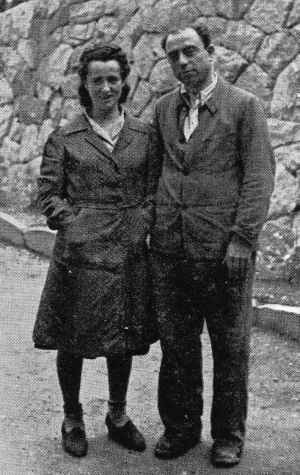
Srul married Lea Staroswiecka, born 20 Mar 1908 in Kaluszyn. They were the first to leave Kaluszyn (Poland) and come to Paris in the 1920s. Their daughter Rachel was born here on 11 Jan 1929.3
He was deprived of Polish citizenship by decision of the Voivode of Warsaw dated July 20, 1931 (case number L. OA. I-8-8/2/31), recorded/updated on the file on 27/39.
In 1939, shortly after the birth of a second daughter, Yvonne, they moved from Paris to Changé 150 km west of Paris.4 In 1940 they moved back to Paris, but in 1941 decided to hide, first in the area around Nice, in the Italian zone of France. On 23 October 1943, the family managed to enter neutral Switzerland.
Yisroel and Laya Engel in a camp in Switzerland – 1944
Srul describes the war time in the Kaluszyn yizkor book, p 456: “Due to the treason of the reactionary fascist circles in France, the Nazi forces with the help of the fifth column quickly conquered a large part of French territory, including the capital. Under the terms of the armistice, France was partitioned into a number of zones: the “free zone” administered from Vichy, the occupied zone, including Paris and the Italian zone, run from Nice. Following the first wave of arrests in 1941, many Jews started to move into the Italian zone, where people felt more secure as long as the Italians were there. The following Kałuszyn Jews with their families were hiding in Nice: Noote Tenenboym, Max Tenenboym, Mordche Teneboym, Yisroel Engel, Mayer Engel (later perished in Auschwitz), Laybl and Bernard Zhitelny, and others. Velvl Safirshtayn was hidden in Clermont; Avrohom Kronenberg and Yankev Mendl Gothelf in Brides-les-bains; Zishe Borovski in Lyon; Mendl Gothelf and Roytman (both subsequently deported) near Toulouse. This is only a part of the Kałuszyn natives, who went into hiding in the various areas in France, most of whom vanished without a trace.”
After the war the family returned to France. They got French nationality on 28 Februari 1948.
Srul was very active to keep the memory of Kaluszyn alive. He was president of the “Administration de l’amicale des originaires de Kaluszyn à Paris”, helping survivors from Kaluszyn.5

Administration de l’amicale des originaires de Kaluszyn à Paris
First row: (Starting from the right)
Yaakov Mendel Gotthelf: Treasurer for the Kaluszyn book, Shmuel Ayzerstein: Vice-President, Israel Engel: President, Velvl Sapirstein: Secretary, Mordechai Cizinski: Finances, Treasurer
Second row: Hershl Mordkovitsh, Avraham Kronenberg, Motl Sukno, Yosef Sukenik, Nathan Borovski, Zishe Borovski
Srul Engiel died around 1982. Children:
4.1.1 Rachel Engiel 1929 – 1 Aug 2019 Menton, France
Married NN Baranek, died 2020
4.1.2 Yvonne Engiel 14-5-1939 Paris – 30 Aug 2019 Compiègne
Married NN Rosonovski
4.2 Chuma / Nehama Engiel 1904 Zelechow

Le mouvement de jeunesse communiste « les pionniers »-1930
Nehama Engel worked in the textile trade (the Engel family business). She supported her brother Meïr Engel in the communist movement. She resolved the problem of sourcing red fabric, necessary for the flags.
She married Laibou Goldstein and moved to Garwolin around 1929/1930.
Children:
4.4.1 Roger Goldstein died around 1959
4.4.2 Bernard Goldstein
4.3 Abram Mayer Engel 1907-1943 X Chaja Ajzersztejn
Abram Majer Engel, known as Meir, was born on October 24, 1907, in Kaluszyn, the hometown of his mother, Fayga Brandel Gothelf. When Meir was five years old, his father, Rubin Engel, left for two years to go to Israel. He returned in 1914 but passed away in 1916 when Meir was eight years old.
Meir likely received a religious Hasidic education but was more interested in communism. During his youth, Meir Engel was a dedicated member of the communist party, actively involved in organizing activities and events. He served on the organizing committee of the young communists.
In addition to recruiting new members, youth activities included self-education through lectures on political economy and discussions on current political themes. The main lecturer was Shmuel Ayzerstein, who later became Meir’s brother-in-law.
In the Kaluszyn Yizkor book,p194, Velvl Sapirstein describes Meir Engel as follows:
“The red flags that often appeared on the telephone poles of Warsaw Street were a great success. Hanging the flag first took a long time, until Meïr Engel took this matter seriously and, thanks to his skilled hands, transformed himself into a pure tool, a sort of “frog”. Once a flag was mounted on the pole, it was impossible to dislodge. We were amused at the police’s inability to remove the flags which, for long minutes, and sometimes hours, shone brightly as the symbol of the bright ideal of dedication of our activists.
One could not conceive of a revolutionary celebration without the red flags of the Communist Party (which were persecuted). They were literally waved in the face of the police, as on May 3, 1929, when, in honor of the Polish national holiday, a joyful parade was organized on Warsaw Street, with the participation of all the dignitaries of the city and even the rabbi. At the precise moment when the procession reached the corner of Olshevitz Street, a red flag fell from the sky and remained hanging on the poles. The police were furious but powerless. The community leaders of Kałuszyn were also displeased with these people who were rebelling against the authorities, but Shaye Shpantser and Yoel Zor were proud that their illegal party, which had not been invited, made its presence felt at the parade…
Meïr Engel, supported by his sister Nehama, who worked in the fabric trade (the Engel house, which we had made our own), had solved the problem of the supply of red fabric needed for the flags. As for Pessah P., he specialized in flag making and painting golden inscriptions. Dvora Dil “lent” her apartment, in Moyshelé Aynbinder’s house (Moyshelé had long suspected his daughters of sympathizing with the “reds,” and caution was necessary).
Our contacts with the surrounding villages were not limited to the pioneer movement. Being the most numerous and with serious party experience, we were seen by them as tutors or elder brothers. We would “scout out” a speaker, make a flag, and teach them how to hang it. Dobry’s comrades renewed their library, our choir quickly expanded, and to reach us, it took winding and strange paths. We arrived breathless, but not late, everything went as expected, the representatives spoke, the choir sang, and we performed a short skit by Shalom Aleichem. In the evening, the talented Meïr Engel did the makeup for the “actors” for the first time and beamed with joy when it was a success.”

Militants de la Jeunesse communiste
From the right: Shmuel Razenboim, Avraham Abrantashki, Meir Engel, Aresh Lis
The majority of the Jewish population of Kałuszyn earned a living as artisans in various occupations – as tailors, shoemakers and other trades. All these trades engaged a considerable number of employees, and before the establishment of the trade unions, conflicts used to arise between the workers and the employers, and occasional strikes (would break out). Thus, even before the emergence of an organized movement, workers struggled for better conditions and higher pay.
The first to organize a union were the turners. In 1924 they established the trade union of woodworkers in Kałuszyn.
The clothing union organized all the clothing workers in town. This union too, fought tenaciously for the interests of its workers. For a time there existed two clothing unions in town – one under the aegis of the “Bund”, the other led by the communists and the Poalei Tsiyon-Left.
Among the activists of the clothing union were: Mayer Engel, Moyshe Tseshinski, and Yocheved Rayzman. The transport union was led by Shmul Ayzershtayn, Motl Roznboym and others.6
Around 1930, Mayer Engel emigrated to Paris and like every new arrival, he lived for several years in difficult conditions. At that time there were about 250 persons from Kaluszyn in Paris7. In 1932, a Kaluszyn patriotism began to be created in Paris. Among the Kaluszyn, there was a friendly bond and mutual help. In the course of time, almost all of the Kaluszyn made their way, and began to feel at home in the busy life of the great world city.

Meir married Chaja Ajzersztejn, sister of Shmul, in 1933. Both worked as tailors. Their son Roger was born in 1934 in the 4th arrondissement of Paris. In 1936, the family lived at 31 Rue Michel Le Comte, Paris 3, together with Serka Ajzerstejn, a sister of Chaja. Presumably they only had one room as there are 28 households listed in the same house in the 1936 census.
He was deprived of Polish citizenshipby decision of the Government Commissionerfor the Capital City of WarsawNo. Ac. 1. 146 of March 15, 1937file 27/37.
Before the war, several others of the Engel, Ajzerstejn, Dobrynski and Gothelf families moved from Kaluszyn to France.
The years went on peacefully until 1939. With the outbreak of war, the great upheaval began.
In 1939, Meir moved to Changé, but returned to France in 1940. Around this time, Chaja got breast cancer -probably genetic BRCA1- and was successfully treated in Paris.
During the evening hours of Monday, the 13th of May 1941, the French police visited all Jewish homes in Paris and left notices with the “modest” request to appear the following morning with documents, accompanied by a family member or friend in order to clarify one’s citizenship status.
Following the first wave of arrests in 1941, many Jews started to move into the Italian zone, where people felt more secure as long as the Italians were there.
In 1943 Meir and his family were hiding in the mountains near Aiguebelette-le-Lac, Savoie, between Lyon and Geneva. A second son was born that year. One day in November 1943, Meir went to get food for his family and for the resistance. He was stopped by a French policeman and transferred to the nazis. He was transported to Drancy on 19 november 1943 and on 20 november deported on convoy No. 62 to Auschwitz.
ENGEL Abram, Majer 36 24/10/1907 Kałuszyn, Masovia, Pologne Journal Officiel Aiguebelette-le-Lac, Savoie Chambéry 62 20/11/1943 n’a pas survécu
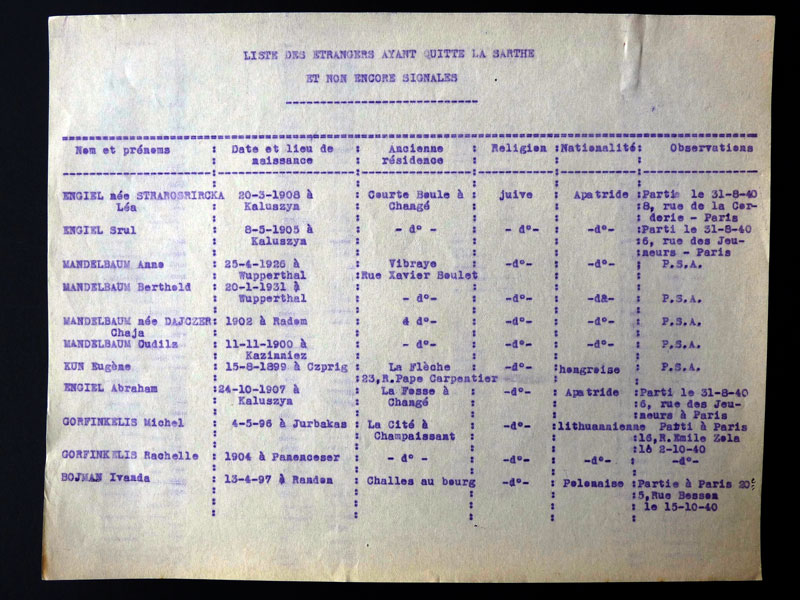
The convoy arrived at Auschwitz during the night of November 22 to 23, 1943. Abraham Meir Engel died in deportation on November 25, 1943, at Auschwitz, Poland.8
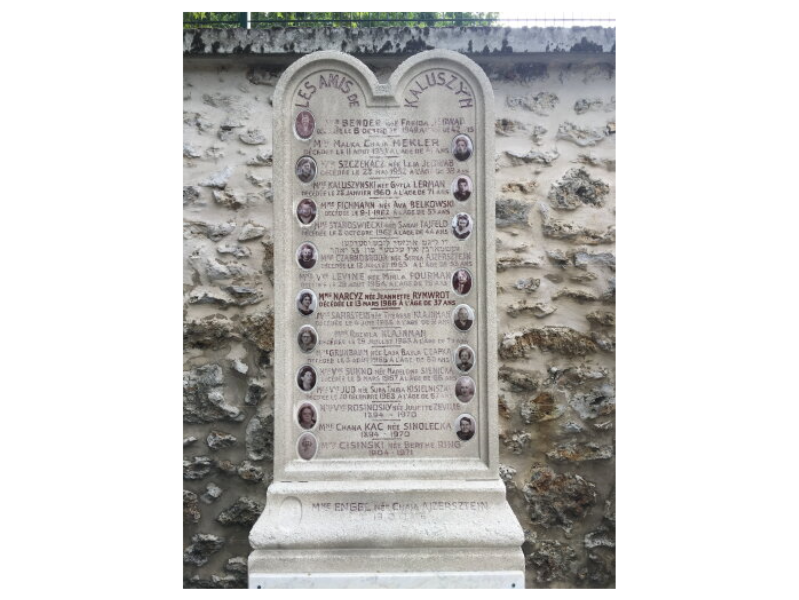
His wife and two children survived the war and lived in France. Chaja Ajzersztejn died on 26 Dec 1976 in Paris, of cancer. She is buried in the Kaluszyn section of the Cemetery Bagneux in Paris.9
4.4 Ruchla Engiel 6 Feb 1909, Zelechow
Her birth certificate was drafted in 192810. No further information.
4.5 Eta E Engel 15 July 1910, Kaluszyn – 8 Jan 2001, California
Engiel Eta – daughter of Rubin and Fajga Brandla Gotelf born 15th of July 1910 in Żelechów.
After the death of her father in 1916, she lived with mother in Żelechów, house number: 270. She was not declared immediately: Her birth certificate dates from the 192811.
Eta married Abraham Isaac Nysenbaum, born 23 May 1904 in Kaluszyn. They moved to Paris, where on 22 Apr 1930 daughter Ida was born. In 1936 they lived in Enfants Rouges, 3e Arrondissement, Paris, Île-de-France, France.
Abraham Isaac Nysenbaum describes their move to Paris and later to Argentina12:
“In the 28th year, after serving in the Polish army, an unrest befell me and I moved to Paris. I felt a strangeness and a loneliness in the city of light, but soon many young people from Kaluszyn began to come, victims of Polish fascism and anti-Semitism. My close ones come, my wife’s brother Meir Engel, Welvel Safirstein, Mashlanke, Hochberg, the Zeshinskis and it becomes homely. Again, we, Kaluszyn, are active in social and cultural life, in the clubs and syndicates. Despite the police persecutions, we root ourselves in with a hope that this will be our home, but once again we are shaken by black hunger. We remember the sad news about a pogrom in Minsk Mazowiecki and that in Kaluszyn.
We come into contact with the colleagues from Minsk and take part in the relief action. We send over our help through Elie Moses, the later famous Andrzej Schmidt, the fighter in Spain. Meanwhile, our Kaluszyner group is getting bigger and bigger. Then the Kaluszyn gathered in Paris to see a film that an American tourist had taken in Kaluszyn. With pain and tears we looked into the streets and alleys of our hometown, trying to recognize the figures. A woman suddenly shouted: Dad!” When she saw him on the screen… This is how we, Kaluszyners, lived and maintained relations in Paris until the war broke out. I still managed to accompany my closest and dearest friends, who volunteered for military service, and in the most difficult stormy days leaving Paris, I embarked on a risky journey with my wife and child until we reach no Argentina. Many of those I said died in the great destruction of millions of saints. My sister Feige Engel, Meir Engel. Gittel Engel, as well as the cousins Mendel, Meir Yehiel, my sister Yochad Elke and her husband Baruch – each with their children.
In such a tragic period, I arrived in Argentina and again I sought contact with Kaluszyner. The Kaluszyn emigration was here from the previous generation. Together with the colleagues from Minsk Mozowietsk we found a framework for joint work. In all the wanderings everywhere, Kaluszyn went with me.“
The family stayed in Buenos Aires, Argentina until 1962. On 27 November 1962 they emigrated to the United States. On 23 June 1972 they became American though naturalization in Los Angeles, California, United States.
Abraham Isaac Nysenbaum died in 1995 in Los Angeles
Eta lived in April 2000 on 5527 Laurel Canyon Blvd, N Hollywood California 91607-2116, USA
She died 8 Jan 2001 in California, United States. Her last residence was Studio City, California 91604, USA
Children:
4.5.1 Ida Nisenbaum 1930, Paris – 4 Sep 2010, Studio City LA
Ida was born 22 Apr 1930 in Paris and moved before the war to Argentina.
She married in 1958 in Buenos Aires to Amor Halperin (12 Jun 1931 Buenos Aires – 8 Jan 2001 Los Angeles). Amor made paintings and wrote poems. They had two children.
Ida died on 4 September 2010 in Studio City, Los Angeles.
4.6 Ruchla Engiel Feb 6 1909, Zelechow Poland
Her birth declaration was only done in 1928.
4.7 Lewek Engiel Nov 7 1911, Zelechow Poland
No information
4.8 Gitel Engiel 1913 , Zelechow Poland – 1942 Auschwitz
Prior to WWII she lived in Kaluszyn, Poland. She married Laybl or Bernard Zhitelny and moved to Paris.
Gitel Zhitelny was (as were many others) a victim of her own naiveté. As she was traveling on 23rd October 1942 to her husband in the so-called “free zone” of the Vichy government, she was arrested on the train and taken to a camp near the border some 400 km from Paris. It was not hard to escape from there, but Gitele believed the Gestapo killers that she would receive only a minor punishment for crossing illegally from one zone to another. However, she was sent to Drancy and from there to Auschwitz. Even there, according to witnesses she at first thought that the smoking chimneys were factories… until she entered the gas chamber13.
- 1 Rabbi Chaim Meir Yechiel (Majer) born 1850
- 2 Rabbi Yahuda Nahub Lejbus (Leib) 1855 – 1948, Israel
- 3 Chuma 1866
- 4 Rubin 1870-1916, Kaluszyn – ancestor
- 5 Lejzor Engiel 1872
Start: Introduction
- https://en.wikipedia.org/wiki/Russian_Revolution_of_1905 ↩︎
- Kaluszyn, akt 134 126 ↩︎
- Tauba Alman, https://data.over-blog-kiwi.com/1/10/37/54/20191106/ob_55bb2e_pnm-368-09-2019.pdf ↩︎
- https://lesdeportesdesarthe.wordpress.com/engiel-srul/ ↩︎
- https://www.jewishgen.org/yizkor/kaluszyn/kalf534.html#Page536 ↩︎
- Pesach Finklshtayn, in Yizkor Kaluszyn: https://www.jewishgen.org/yizkor/kaluszyn/kal204.html ↩︎
- Motel Sukne, Yizkor Kaluszyn, p 458 ↩︎
- https://lesdeportesdesarthe.wordpress.com/engiel-abraham/ ↩︎
- https://www.geneanet.org/cimetieres/view/8026825/persons/?individu_filter=ENGEL%2B ↩︎
- Act 205 year 1928 Zelechow ↩︎
- Act 206 year 1928 Zelechow ↩︎
- Yizkor Kaluszyn ↩︎
- https://www.jewishgen.org/yizkor/kaluszyn/kal437.html#Page456 ↩︎