The bible
Jacob 1820 BC
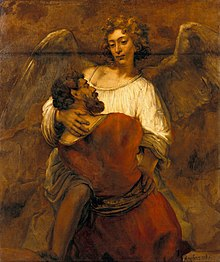
Jacob Wrestling with the Angel, by Rembrandt
Jacob, later given the name Israel, is regarded as a patriarch of the Israelites. Jacob had twelve sons through four women. His sons were, in order of their birth: Reuben, Simeon, Levi, Judah, Dan, Naphtali, Gad, Asher, Issachar, Zebulun, Joseph, and Benjamin, all of whom became the heads of their own family groups, later known as the Twelve Tribes of Israel.
Levi
Levites are Jewish males who claim patrilineal descent from the Tribe of Levi. The Tribe of Levi descended from Levi, the third son of Jacob and Leah. A titular use of HaLevi indicates being a Levite. All have the R1a-Y2619 genetic variation.
The Tribe of Levi served particular religious duties for the Israelites and had political (administering cities of refuge) and educational responsibilities as well.
In the Book of Genesis, Levi is described as having fathered three sons—Gershon, Kohath, and Merari.
Kohath
According to the Torah, Kohath was one of the sons of Levi and the patriarchal founder of the Kohathites, one of the four main divisions of the Levites in biblical times. The Torah ascribes a specific religious function to the Kohathites, namely care of the vessels and objects within the sanctuary: the Ark of the Covenant.
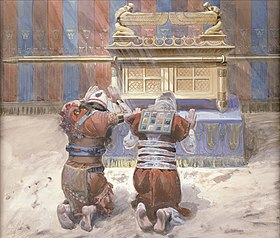
Moses and Joshua bowing before the Ark (c. 1900) by James Tissot
In the Book of Exodus, Kohath has four sons, Amram, Izhar, Hebron and Uzziel.
Izhar
According to the Torah, Izhar was the uncle of Moses. No further details of his life are given by the Bible, and according to some biblical scholars the genealogy for Levi’s descendants is actually a myth, reflecting popular perception of the connections between different Levite factions.
The Prophet Samuel 1070 – 1012 BC
Horowitz family tradition traces the family’s roots back to Samuel Halevi, the prophet and judge who anointed Kings Saul and David 3,000 years ago.
Samuel is a figure in the narratives of the Hebrew Bible and venerated as a prophet in Judaism, Christianity, and Islam. Samuel’s father was Elkanah who, according to the genealogical tables in Chronicles, was a Levite—a fact not mentioned in the books of Samuel.
Exodus from Israel to Spain 70 BCE – 1391
In 70 BCE the Roman army led by future emperor Titus besieged Jerusalem. Following a five-month siege, the Romans destroyed the city and the second temple.
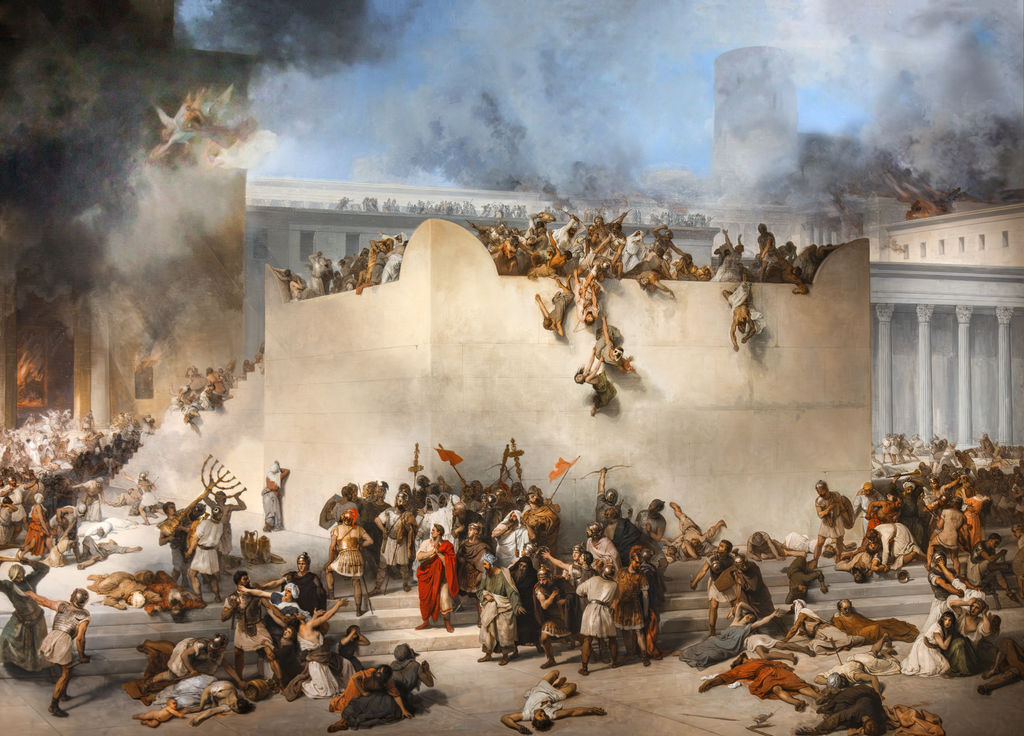
Destruction of the Temple in Jerusalem by Francesco Hayez. 1867.
Many Jews were expelled and went as far as the countries Germany, France and Spain.
As citizens of the Roman Empire, the Jews of Spain engaged in a variety of occupations, including agriculture. Until the adoption of Christianity, Jews had close relations with non-Jewish populations, and played an active role in the social and economic life of the province.
Barbarian invasions brought most of the Iberian Peninsula under Visigothic rule by the early 5th century. First they did not generally take much of an interest in the religious creeds in the kingdom. This changed following the conversion of the Visigothic royal family to Catholicism in 587. In their desire to consolidate the realm under the new religion, the Visigoths adopted an aggressive policy concerning the Jews. In 694, at the Council of Toledo, Jews were condemned to slavery by the Visigoths.
The invasion of the Moors in 711 was welcomed by the Jews of Iberia. To Jews throughout the Catholic and Muslim worlds, Iberia became a land of relative tolerance and opportunity. The native Jewish community was joined by Jews from the rest of Europe, as well as from Arab territories from Morocco to Mesopotamia.
The reconquest of Catalonia began under the auspices of the Frankish kings, who forced the Muslims who had managed to cross the Pyrenees at the Battle of Poitiers in 732 to retreat to the south. All the lands freed from the Islamic domain became counties and remained under the administrative organization of the Franks. The Catalan counties, led by the counts of Barcelona, slowly broke free from the Franks and began to govern themselves independently. Old Catalonia became a zone of containment (Marca Hispanica) against the spread of Islam.
Jews often moved from Sepharad (the Muslim zone) to the northern lands (the Christian kingdoms), and vice versa. The fact that many of them spoke Arabic and also the vernacular Romance languages enabled them to serve as translators and acquire important positions in both Muslim and Christian governments. Jews owned fields and vineyards and many engaged in agriculture.
Barcelona and Girona were known as important Jewish communities from the 9th century CE. In the 11th and 12th centuries there was a rabbinical court (Bet Din) and an important center for Torah study in Barcelona.
In the 12th and 13th centuries the Catalonian Talmudic academies thrived.
Spain and France
Some attribute the roots of the family to the members of the Halevi family in Bennashti from Narbonne and Lunil in the south of France and Girona in the north of Spain in the 11th century, their direct male ancestor is believed to be Shem Tov Halevi of Girona:
Shem Tov Ha-Levi, 1035 Girona, Spain – 1110 Provence, France
One of the greatest Talmudic scholars in Provence, who claimed direct descent of the prophet Samuel, who according to Jewish tradition was a direct descendant of Yitzhar (hence the family name “Ha-Yitzhari”), son of Kehath, son of Levi, son of Jacob who was born in 1820 BC.
He was the grandfather of Zerachiah ben Isaac Ha-Levi.
Zerachiah ben Isaac ha-Levi Gerondi, 1115 Gerona – 1186 Lunel, France
Rabbi Zerachiah ben Isaac Ha-Levi, known as Baal Ha-Maor, was a prominent Tosafist—a rabbinic scholar who wrote commentaries on the Talmud. His nickname, “Baal HaMaor,” meaning “Master of Light,” stems from his renowned work, “HaMaor,” a commentary on sections of the Talmud. These Talmudic commentaries held significant influence and continue to be studied and respected within the Jewish scholarly tradition.
In addition to his expertise in Torah and Talmudic commentary, Rabbi Zerachiah was a celebrated poet and a scholar well-versed in Arabic literature, philosophy, and astronomy. Born around 1115 in the town of Gerona, Catalonia, Spain, he hailed from the family “Ha-Yitzhari,” which claimed direct descent from Yitzhar, son of Kohath, son of Levi, son of Jacob.
Roger’s grand-uncle, Lejb Engel, Rubin’s brother, was believed to be a descendant, “son after son,” of Rabbi Zerahiah Halevi Baal HaMaor, and thus also son after son of from Levi and Jacob.
Rabbi Zerachiah passed away after 1186 in Lunel, near Montpellier, France, leaving behind a lasting legacy of scholarly excellence and contributions to Jewish learning.
Over the next two centuries the family’s direct male ancestors moved between Provence (now in France) and Aragon (now in Spain). Rabbi Zerachiah descendants continued to live in the region of southern France and Girona, and maintained contact with the sages of Provence and Girona. Traces of the family are noted in the cities of Narbonne, Montpellier and Lonil in Provence and Girona in northern Spain.
Expulsion from Spain to Prague
There were about 120 Jewish communities in Catholic Spain around 1300, with somewhere around half a million or more Jews, mostly in Castille. Catalonia, Aragón, and Valencia were more sparsely inhabited by Jews.
Even though the Spanish Jews engaged in many branches of human endeavor—agriculture, viticulture, industry, commerce, and the various handicrafts—it was the money business that procured to some of them their wealth and influence. Kings and prelates, noblemen and farmers, all needed money and could obtain it only from the Jews, to whom they paid from 20 to 25 percent interest.
In the beginning of the fourteenth century the position of Jews became precarious throughout Spain as antisemitism increased
The year 1391 forms a turning-point in the history of the Spanish Jews. The Massacre of 1391, also known as the pogroms of 1391, was a display of antisemitism and violence against Jews in Castile and Aragon and the majority of the Jewish communities of Sepharad, Catalonia and Aragon were destroyed. It was one of the Middle Ages’ worst antisemitic outbreaks.
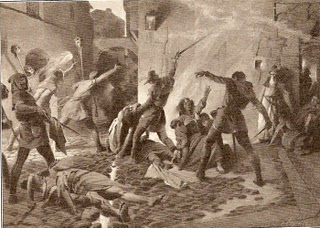
Slaughter of Jews in Barcelona in 1391 (Josep Segrelles, c. 1910)
There was also a great massacre of the Jews of Girona in that year, which made Rabbi Yosef Halevi decide to move from Girona to the region of Bohemia, (now the Czech Republic ).
Rabbi Yosef Halevy and his son Rabbi Moshe Halevy apparently settled in a town called Horowice, today in the western Czech Republic, 50 km west of Prague.
The Spanish origin of the Horowitz family is controversial. In 2016, Avrohom Marmorstein argued that the Horowitz family didn’t claim Spanish ancestry until the late 19th century. In the Geni-world family tree, the link with the Spanish ancestors was removed.
The material collected for this family history refers to research by Edward Gelles in 2016 and by Meir Halevi Gover in 2017. Gover identified the Y-chromosome mutation R1a-YP268, which he called the Horowitz Identifier Mutation, among male descendants of the Horowitz family. He claims that the first carrier of the mutation was Rabbi Yosef Halevi.
Previous: Introduction
Next: The Horowitz Family